How “Life Without Ed” Changed Everything for Me
For as long as I can remember, there was a voice in my head—a constant stream of negative thoughts.
I never experienced it as my own voice. It felt separate from me, distinct, like someone else living inside my head. I ended up calling him Ed. I don’t even remember exactly when that started, but I do remember why: the things he said to me were so cruel, so constant and all tied to ‘food and weight’, so I named him after my eating disorder.
That voice wasn’t guiding me—it was tearing me down. It told me I was disgusting, that I was fat, that nothing I did mattered anyway. Sometimes it would push me to eat, almost mockingly, like, “just go ahead, what difference does it make?” There was nothing calm or encouraging about it. It was relentless.
As a teenager, I struggled a lot and spent years in and out of therapy, including group therapy with other girls dealing with eating disorders. And one thing always stood out to me: their inner voices didn’t sound like mine. Theirs seemed quieter, more controlled—even persuasive. Mine felt aggressive, chaotic, and mean.
Because I already experienced it as something separate—because I called it him—I started to feel like I was the only one whose mind worked this way. No one around me described it like I did, and no therapist ever framed it that way either. Everything was always brought back to me—my behavior, my choices, my lack of control. I genuinely felt crazy.
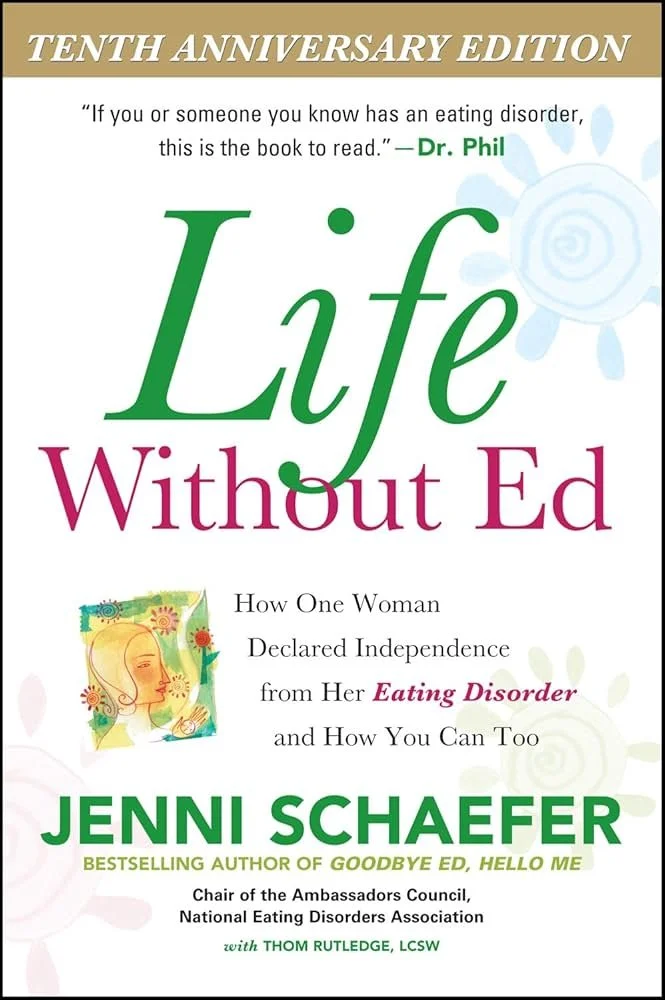
Then I read Life Without Ed.
And everything shifted.
For the first time, someone described exactly what I had been living with. She didn’t just talk about the eating disorder—she separated it. She gave it a name. A personality. An identity that wasn’t her.
Ed.
Just like I had.
That was the moment I stopped feeling alone. It was the first time I felt understood, validated, and—maybe most importantly—sane. There wasn’t something uniquely wrong with me. There was a pattern, a voice, something that other people experienced too.
Her book became my saving grace, not because it fixed everything overnight, but because it gave me a completely different way to understand what was happening in my own mind. It gave me permission to stop identifying with that voice—to question it, to push back, to separate myself from it.
That realization changed everything.
It’s also where “Drop Dead, Ed” comes from. (Well more like, FUCK YOU ED, about 30 times a day).
Because for me, recovery didn’t start with food—it started with recognizing that the voice tearing me apart was never me to begin with.